
From Chaos to Clarity: Why AI-First Processes Outperform Adding More Staff for Movers
Moving operations feel chaotic because calls, estimates, scheduling and upsells all run through people-heavy workflows that break when call volume spikes or staff turnover rises. This piece shows why making process the priority—specifically by automating with AI—produces more consistent results than simply hiring more people. You’ll see how movers can recover lost revenue, lower operating costs, and scale reliably. We walk through the hidden costs of manual labor, how AI voice agents and scheduling automation remove friction, and real use cases that drive revenue—instant estimates, automated upsells, and more. You’ll get practical workflows, side-by-side comparisons and cost models, and a look at how agent data turns noisy operations into repeatable, measurable improvements. Finally, we point to real-world outcomes and next steps for operators evaluating AI automation for movers, including how AI Voice Agents connect with common moving CRMs.
What Are the Hidden Costs of Relying on Manual Manpower in Moving Operations?
Relying on people for every part of the customer journey hides steady, often-overlooked costs that eat into margins and stunt growth. When teams depend on humans to answer calls, qualify leads and coordinate dispatch, inconsistent response times, busy lines and missed follow-ups translate directly into lost bookings and wasted ad spend — a pattern often tied to cost staff moving leads and the operational drag created by manual handling. Recruiting, training and overtime inflate staffing budgets, while uneven service quality drives refunds and hurts reputation—reducing lifetime customer value. Recognizing these hidden costs explains why a process-first approach, backed by automation, recaptures revenue and steadies operations.
You can surface those hidden costs with a few practical operational metrics that make inefficiency measurable.
- Missed-call rate: Share of inbound leads not answered on first contact.
- Average response time: Time from lead arrival to first meaningful outreach.
- Dispatcher queue length: Number of unresolved scheduling tasks per dispatcher.
- Overtime hours per month: A proxy for understaffing and peak-period failures.
These metrics map directly to revenue leakage and should be tracked as part of any improvement program. The next section shows how missed leads and overloaded dispatchers translate into measurable lost bookings.
How Do Missed Leads and Dispatcher Overload Impact Moving Company Efficiency?
Missed leads and overloaded dispatchers create a cascade: fewer booked moves, shakier schedules, and more customer frustration. When a lead sits unanswered for minutes or hours, conversion rates drop fast—benchmarks show near-instant responses materially improve bookings, while delays hand demand to competitors. Dispatcher overload adds friction: manual triage, back-and-forth scheduling and frequent reschedules increase labor hours and customer complaints. Track missed-call rate, average response time and booking conversion per lead to quantify how many opportunities slip through the cracks and where automation will deliver the biggest returns.
With that operational diagnosis in hand, it’s easier to see why simply adding staff is often a short-term and costly fix.
Why Are Labor Costs a Major Challenge for Moving Companies?
Labor expenses are multi-layered: base pay, overtime, recruiting and onboarding, training, plus the productivity drag of inexperienced staff. High turnover in customer service and dispatch means repeated hiring and retraining that pull managers away from strategic work; seasonal overtime causes volatile P&L swings. Hiring to meet volume growth creates capacity that scales linearly—and it rarely improves response times quickly enough to protect marketing ROI. Looking at labor as cost-per-lead-handled versus a process-automated alternative reveals when manpower becomes the more expensive option.
Next, we show how AI automation targets these failure points and brings operational clarity back to the business.
How Does AI Automation Streamline Moving Operations and Reduce Chaos?
AI automation replaces brittle human handoffs with predictable, instrumented processes that capture leads, qualify prospects and coordinate scheduling consistently. Core features include always-on voice qualification, instant estimate generation, automated dispatch triage and CRM-integrated handoffs that cut missed connections and speed response. By putting AI at the front of the funnel, operators convert more marketing spend into booked moves while lightening the load on dispatchers and sales reps. Tight CRM integration gives you a single source of truth for every job, enabling accountability and continuous improvement.
Key ways AI automation reduces chaos:
- Faster lead response: instant qualification and routing to the right queue.
- Consistent scripting: standardized intake that reduces errors and rework.
- Automated scheduling: immediate calendar checks and tentative holds to avoid double-booking.
Each mechanism removes a common friction point; together they deliver compounding operational gains. Below we make those gains tangible by outlining specific agent roles and how they fit into daily workflows. Stacked AI’s product suite includes AI Voice Agents built for moving operators: 24/7 availability, instant response and CRM integration with platforms like SmartMoving and Supermove. These agents handle inbound lead capture, dispatch triage and upsell conversations so internal teams can focus on high-value exceptions. The table that follows breaks down common agent types and their core attributes.
What Roles Do AI Voice Agents Play in Moving Company Workflows?
AI Voice Agents take on repeatable front-line tasks so human staff handle exceptions and complex judgments. Typical agents include Sales Agents that qualify leads and schedule estimates, Dispatch Agents that check availability and assign crews, Upsell Agents that offer packing or storage, and Recruiting Agents that screen applicants. These agents cut manual handoffs by performing immediate qualification, recommending next steps and updating CRM records in real time. The table below compares agent types to make those roles concrete.
| Agent Type | Primary Function | 24/7 Availability | Typical Impact | CRM Integration |
| Sales Agent | Qualifies leads and books estimates | Yes | Higher lead capture and conversion | Creates leads, status updates and notes |
| Dispatch Agent | Triages requests and assigns crews | Yes | Fewer scheduling conflicts and manual calls | Syncs bookings and crew assignments |
| Upsell Agent | Presents add-ons before and after booking | Yes | Increases average order value (AOV) | Records upsell items and consent |
| Recruiting Agent | Screens applicants and schedules interviews | Yes | Speeds hiring and pre-qualifies candidates | Logs candidates and screening results |
This comparison shows where agents reduce operational burden and where humans remain essential for nuanced decisions. Next, we explain why 24/7 availability amplifies these gains.
How Does 24/7 AI Availability Enhance Customer Service and Lead Response?
Always-on AI coverage closes the window of missed contact that costs movers bookings and wastes ad dollars. Instant responses capture intent while it’s fresh—improving conversion—and deliver consistent information outside standard hours, which boosts customer perception and cuts repeat inbound requests. Continuous availability handles peak-season surges without proportional headcount increases, shifting costs from variable labor to predictable automation spend. To quantify the value, operators can model conversion lift per hour reduced in response time and multiply by average move value to estimate recovered revenue.
With response consistency addressed, the next section covers direct revenue impacts and upsell strategies.
How Can AI Voice Agents Boost Sales and Revenue for Moving Companies?
AI Voice Agents increase revenue by speeding lead capture, qualifying accurately, delivering instant estimates, running automated follow-ups and executing timely upsells—filling gaps human teams miss. Instant estimates reduce friction at pricing, keeping prospects engaged; automated follow-ups recover warm leads that would otherwise go cold. Upsell agents present relevant offers during confirmation and scheduling windows, raising average order value without extra outbound labor. Combined, these capabilities convert more clicks and calls into booked moves and higher per-move revenue.
Primary revenue levers include:
- Instant estimates that shorten buying cycles.
- Automated follow-ups that recover warm leads.
- Personalized upsells that lift AOV without adding staff.
The table below contrasts AI Sales and Upsell Agents with traditional human sales staff on response time, conversion lift and handling cost.
| Role | Lead Response Time | Conversion Lift | Cost per Lead Handled |
| AI Sales Agent | Seconds | +10–30% (benchmark range) | Lower, predictable cost |
| AI Upsell Agent | Immediate after booking | +5–15% AOV uplift | Low incremental cost |
| Human Sales Staff | Minutes–hours | Variable (depends on hours) | Higher hourly labor cost |
This illustrative comparison explains why automating core sales tasks can pay back faster than hiring additional reps. Below we cover the specific benefits and KPIs to watch.
What Are the Benefits of AI Sales Agents for Lead Generation and Conversion?
AI Sales Agents provide faster, more consistent intake and qualification, freeing human closers to focus on the highest-value opportunities. They run scripted qualification flows, capture essential move details and can tentatively schedule estimates while pushing structured leads into CRM for follow-up. Benefits include less lead leakage, predictable intake volume and clearer tracking of marketing ROI since every interaction is logged. Track KPIs like lead-to-booking rate, average response time and cost per booked move to measure agent impact.
Those benefits naturally extend to upsells, where timing and personalization matter most.
How Do AI Upsell Agents Increase Profitability After Booking?
AI Upsell Agents use booking and customer data to suggest relevant add-ons—packing, valuation coverage, storage or expedited services—at moments when customers are receptive. Presenting personalized offers during confirmation or pre-move reminders increases AOV with minimal incremental cost and without stretching human teams. Script testing uncovers the best offers and timing, and automated billing smooths acceptance. Track AOV uplift and attribute it to the agent to quantify incremental revenue per booking.
Next we make the strategic case for optimizing process before adding manpower.
Why Is Process Optimization More Strategic Than Manpower in Moving?
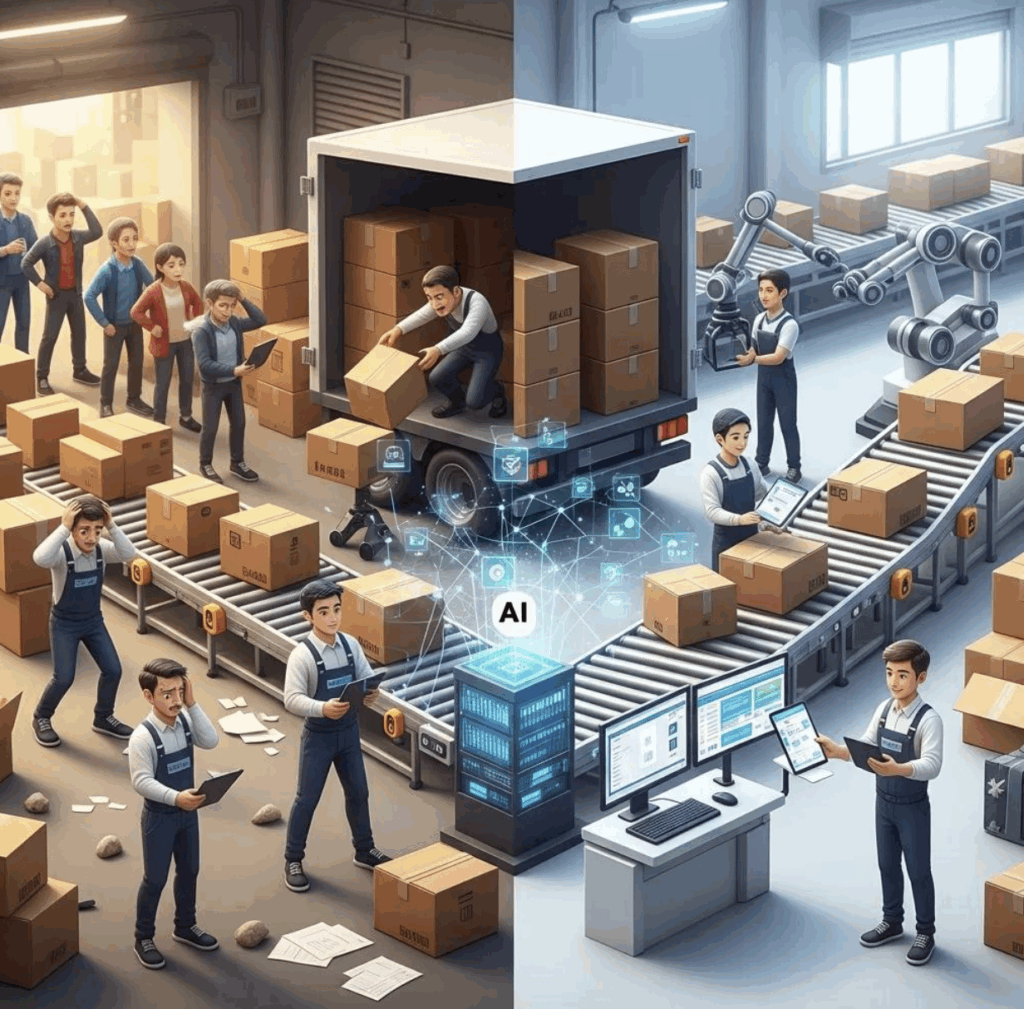
Process optimization delivers non-linear capacity gains: well-designed automation handles spikes, enforces consistency and cuts training overhead in ways headcount increases cannot. A process-first approach replaces variable human performance with repeatable, measurable workflows that scale without proportional cost or management load. Over time, automated processes collect structured data—call transcripts, conversion funnels and FAQ trends—that feed continuous improvement and make marketing and ops spend more efficient. That long-run view shows process-driven AI often gives a better total cost of ownership and faster payback than incremental hires.
How Does Process-Driven AI Enable Scalability and Consistency?
Process-driven AI scales capacity without linear labor growth by automating routine touches and enforcing uniform intake that reduces errors and rework. While a human might handle dozens of leads a day with variable quality, AI provides consistent qualification and routing at any hour—keeping service steady during peaks. Less rescheduling and fewer complaints make the pipeline more predictable and help managers forecast staffing and resources. That predictability makes marketing investments safer because increased demand can be captured efficiently.
Consistent processes also produce richer data—insights that power targeted operational improvements.
What Data-Driven Insights Do AI Solutions Provide to Moving Companies?
AI agents produce structured analytics—lead source breakdowns, conversion funnels, common cancellation reasons, FAQ trends and dispatcher load metrics—that highlight bottlenecks and reveal which marketing channels perform. Dashboards that surface these signals help prioritize fixes (for example, improving pages that drive low-quality leads or reworking scripts that cause drop-off). Regular reporting and A/B testing of scripts or upsell offers turn guesses into measurable experiments. Those insights close the loop between customer interactions and operational change, accelerating improvement cycles.
With process and data advantages laid out, we next look at real-world results and how vendors demonstrate impact.
What Real-World Results Demonstrate the Impact of AI in Moving Companies?
Companies that adopt voice-AI and automation report measurable gains in lead capture, response time and cost efficiency—results that convert into more bookings and healthier margins. Case summaries often show conversion lifts, reduced average handling time and lower cost per lead after automating intake and scheduling. In many instances, reclaiming missed leads alone pays for automation within months by converting previously lost opportunities into booked moves. These concrete metrics and short client snapshots help operators estimate impact for their own volumes and budgets.
Here are anonymized, illustrative outcome highlights that reflect common results and next steps for evaluation.
- Many operators report double-digit increases in captured leads after adding 24/7 AI intake.
- Dispatch automation typically reduces scheduling conflicts and reschedules by a measurable margin.
- Upsell automation drives modest AOV gains that compound across monthly bookings.
These types of outcomes point to practical evaluation steps; the subsection below connects those improvements to Stacked AI demos and pilots.
How Have Moving Companies Improved Efficiency and ROI with Stacked AI?
Clients using Stacked AI’s Voice Agents see benefits from 24/7 lead capture, instant estimates and CRM-synced dispatching that reduce manual work and convert more ad spend into booked moves. Typical improvements include higher captured-lead rates, faster scheduling cycles and visible conversion gains when AI handles initial qualification and booking. Operators wanting to validate ROI can request demos and instant-estimate showcases to watch agent behavior on real workflows and discuss integrations with CRMs like SmartMoving and Supermove.
After reviewing client outcomes, the next subsection explains where operators can observe demos and evaluate fit.
Where Can You See Examples of AI Transforming Moving Workflows?
Evaluate AI impact by watching product demos that simulate inbound lead handling, instant estimate delivery and dispatch triage. When reviewing demos, focus on script fidelity, escalation rules and CRM sync behavior. Look for accurate transcription, clear handoff thresholds to humans and evidence of how the agent writes into your CRM and analytics dashboard. Request sample call scripts and demo performance metrics, then compare those to your baseline KPIs—these artifacts reveal whether a solution reduces the specific types of chaos you face and justify a pilot.
With demos and evaluation guidance covered, many buyers still have practical questions—addressed in the next section.
What Are the Most Common Questions About AI Automation in Moving?
Operators often ask about availability, integration complexity, cost savings, accuracy and the transition from manual to automated workflows. Short, clear answers reduce buyer friction: AI delivers always-on coverage with escalation to humans, integrates with major CRMs via APIs and replaces predictable portions of staff workload while keeping human oversight. Cost savings depend on call volume and local labor rates, but most ROI models show payback in months when automation captures missed leads and cuts overtime. The Q&A below addresses top concerns and helps teams plan pilots with measurable success criteria.
- Integration with existing CRMs: Agents typically push structured lead and booking data into CRM fields to maintain a single source of truth.
- Accuracy and guardrails: Scripted guardrails and monitoring keep answers consistent, with escalation thresholds for ambiguous or high-value calls.
- Pilot approach: Start with a focused channel (for example, after-hours intake) to measure conversion lift before broader rollout.
The following subsections expand on 24/7 handling and cost comparisons so operators can model expected outcomes.
How Does AI Help Moving Companies Handle Customer Inquiries 24/7?
AI provides continuous coverage by answering inbound calls and messages, qualifying leads and capturing structured details for human teams to act on during business hours. Fallback flows escalate ambiguous or high-value leads to a live rep based on predefined thresholds, preserving quality while ensuring no lead is silently lost. Monitoring and quality-control—call review, transcript sampling and KPI dashboards—maintain performance and support iterative improvement. This always-on model boosts customer satisfaction and makes marketing-to-booking flow more reliable.
These operational benefits feed directly into the cost comparisons most buyers request when justifying automation.
What Are the Cost Savings of Using AI Voice Agents Compared to Human Staff?
Compare the two approaches simply: humans carry hourly wages, overtime spikes, recruiting and training costs, and variable throughput; AI carries predictable subscription or usage fees, a lower marginal cost per interaction and higher capture rates that lift revenue.
The illustrative EAV table below lines up Human Staff versus an AI equivalent and the estimated savings for a typical handling volume, with assumptions noted for clarity. Use this framework to test sensitivity to call volume and average move value when estimating payback and ROI.
| Approach | Assumption | Illustrative Value / Impact |
| Human Staff | Average fully loaded hourly cost | Example: $25–40/hr (assumption) |
| AI Equivalent | Monthly subscription + usage | Predictable monthly cost, lower per-interaction cost |
| Estimated Savings | Based on recovered leads and reduced overtime | Varies by volume; often breakeven in months |
This model helps operators run sensitivity tests with local wage rates and lead volumes to estimate payback.
The final step after modeling is a small pilot to measure the actual delta in captured leads and booked moves and validate projected savings.
Artificial Intelligence and Robotic Process Automation: Enhancing Efficiency, Mitigating Costs, and Assuring Quality in Business Operations
A comprehensive review that defines AI’s role in process automation and highlights how robotic process automation can boost efficiency, reduce costs and improve quality in business operations.
Technology dimensions of automation in business process management industry, S Mishra, 2019
AI Virtual Agents in Customer Relationship Management: Advancing Customer Service and Process Automation
This research explains how virtual agents enhance omnichannel engagement, enable intelligent self-service and provide proactive support. It covers intelligent routing, complex process handling and how operational intelligence drives organizational learning.
AI-Powered Virtual Agents in CRM: Revolutionizing Customer Interaction and Service Automation, GRS Chowhan, 2025
Frequently Asked Questions
What types of AI technologies are most beneficial for moving companies?
Moving companies benefit from AI Voice Agents, chatbots and machine-learning models. Voice agents handle calls and lead qualification, chatbots cover FAQs and simple scheduling, and ML models surface pricing or demand patterns. Together these tools improve service, simplify operations and increase bookings.
How can moving companies measure the success of AI automation?
Measure success with KPIs like lead conversion rate, average response time and customer satisfaction. Also track reductions in missed leads and operational cost. Regularly reviewing these metrics shows where automation is working and where to iterate.
What challenges might moving companies face when implementing AI solutions?
Challenges include integrating with legacy systems, managing staff adoption and investing in initial setup and training. Overcome them with a clear rollout plan, focused pilots, staff training and by aligning automation with operational goals.
How does AI improve customer experience in the moving industry?
AI speeds replies, provides consistent information and personalizes offers. Voice Agents capture leads 24/7, while analytics help tailor recommendations and upsells. That responsiveness builds trust, leading to repeat business and referrals.
What role does data analytics play in optimizing moving operations with AI?
Data analytics turns interactions into insight: you can spot funnel drop-offs, identify common cancellation reasons and measure dispatcher load. Those insights guide scripting, staffing and marketing changes that improve outcomes over time.
Can AI solutions be customized for specific needs of moving companies?
Yes—AI platforms are configurable. You can tailor lead qualification scripts, scheduling rules and reporting, and integrate with your CRM. Customization ensures the solution supports your workflows and KPIs.
Conclusion
AI-driven processes materially improve moving operations by automating lead capture, scheduling and upselling—driving more bookings and better margins. The real value is predictable, 24/7 performance that reduces missed opportunities and frees teams to focus on complex, high-value work. By prioritizing process and using AI where it fits, moving companies can scale more reliably and make smarter operational decisions. Learn how tailored AI solutions can transform your moving business today.